Posts

Showing posts with the label preventive dental care

How to Brush Your Teeth Properly: A Quick Guide

Image
Below is an excerpt from an article found on Colgate.com that was written by AM Hopkins Everyone knows that brushing their teeth plays a major role in their overall health, but they may not be aware of the correct way to brush their teeth. The American Dental Association recommends that you brush your teeth at least twice each day; here is a quick guide to ensure you know how to do it properly. Purchase the right toothbrush. Before you even begin the process of brushing your teeth, it's important that you have the right toothbrush. The type of toothbrush you select depends on your specific needs. If you need a toothbrush mostly for removing plaque, a soft-bristled brush is best. On the other hand, if you are concerned about reaching hard-to-reach spaces, you should consider a toothbrush with a smaller head. in the Colgate Oral Care resources. Take your time. You should spend at least two minutes brushing your teeth. This may seem like a long time - the average person usual...

Periodontal Screening

Image
Learn more about what the American Dental Association has to say about Periodontal Screening! Park Dental of Colmar   James H. Park, DMD 2200 N. Broad Street Colmar, PA 18915 (215) 716-7228 ParkDentalColmar.com

What 10 Common Mouth Issues Really Look Like (Part 3 of 3)

Image
You know good dental habits can help prevent things like cavities and gingivitis, but you may not know what conditions like these really look like or how they can affect your mouth. Use this visual guide to learn more about some of the most common dental health issues, symptoms to watch for and the potential treatments that are available. Please note: This content is for informational purposes only. Only a dentist, physician or other qualified health care professional can make a diagnosis. Darkened Tooth There are two reasons your tooth may change color after trauma : It’s either trying to protect the nerve or it’s dying. If it’s protecting the nerve, your tooth may look a little darker than the ones next to it. If it changes colors like a bruise (from pink to gray), this means your tooth is most likely dead. You may need a root canal , usually followed by a crown . In some cases it may be necessary to remove the tooth . If it is a baby tooth , you may be able to leave it alone un...

Patient Credits Her Dentist With Saving Her Life

Image
Watch an ADA video, where a patient credits her dentist with saving her life. The above video is found on the American Dental Association YouTube Channel. Park Dental of Colmar   James H. Park, DMD 2200 N. Broad Street Colmar, PA 18915 (215) 716-7228 ParkDentalColmar.com

The Top 7 Risk Factors for Oral Cancer (Part 3 of 3)

Image
You know your dentist is looking for cavities during regular check-ups, but you may not realize your dentist can check for cancer at the same time. It’s estimated that approximately 51,540 people will be diagnosed with oral cancer and cancers of the throat, tonsils and back of the tongue in 2018. Sunlight  People who have jobs working outside are more prone to developing lip cancer and should use UV protection. Diet  Poor nutrition also may put you at risk for developing oral cancer. A diet low in fruits and vegetables may increase your chance of developing oral cancer, so add more color to your plate!    To read the entire article visit MouthHealthy.org . Park Dental of Colmar   James H. Park, DMD 2200 N. Broad Street Colmar, PA 18915 (215) 716-7228 ParkDentalColmar.com

The Top 7 Risk Factors for Oral Cancer (Part 2 of 3)

Image
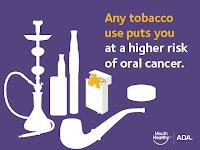
You know your dentist is looking for cavities during regular check-ups, but you may not realize your dentist can check for cancer at the same time. It’s estimated that approximately 51,540 people will be diagnosed with oral cancer and cancers of the throat, tonsils and back of the tongue in 2018. Tobacco  Whether you smoke it or chew it, tobacco use increases your risk dramatically. Smoking can cause oral cancer, as well as cancer in other parts of the body. Pipe smokers are also at a higher risk for developing cancer in their lips. Smokeless tobacco, like chew, can lead to many issues in your mouth, the most serious being cancer of the cheeks, gums, and lips.   Alcohol  According to the American Cancer Society, 7 of 10 oral cancer patients are heavy drinkers. Heavy drinking, as defined by the Centers for Disease Control and Prevention (CDC), is an average of two drinks a day or more for men and an average of more than one drink a day for women. If you are a...

The Top 7 Risk Factors for Oral Cancer (Part 1 of 3)

Image
You know your dentist is looking for cavities during regular check-ups, but you may not realize your dentist can check for cancer at the same time. It’s estimated that approximately 51,540 people will be diagnosed with oral cancer and cancers of the throat, tonsils and back of the tongue in 2018. Regular visits to your dentist can help you detect such cancers early, and changing a few potentially harmful habits may help reduce your chances of developing them. Read on to find out the top risk factors. Gender  Men are twice more likely to get oral cancer. The American Cancer Society attributes this to higher rates of alcohol and tobacco use by men, but says more men of a younger age are being diagnosed with HPV-related forms of oral cancer.   Age  Most people who are diagnosed with oral cancer are 55 or older, according to the American Cancer Society. HPV-related oral cancers, however, are often diagnosed in people who are younger.   ...

Tooth Enamel

Image
Tooth enamel is very hard but... That doesn't mean you can't break it. Our office recommends to avoid eating "hard foods" such as popcorn. Don't crack nut shells with your teeth or chew on ice. Opening packages with your teeth can also damage the enamel. It's not just the sugar - it's also the acid Sugar and acids are your teeth's worst enemies. What are we talking about? Soft drinks, energy drinks, fruit juices, and candy. Because of the acid content, Mountain Dew seems to be the worst of the worst. There is even a name for the damage it does and it is called "Dew Mouth." These erode the tooth enamel, making it highly susceptible to decay. Parents, watch your kid's consumption of these because young children's enamle hasn't developed fully. This makes these drinks even more damaging for kids. As well as eliminating the above (or at least reducing their consumption), it is recommended to always brush and floss after ev...